


Discover how to improve your cost value reconciliation to keep your company growing.
An accurate estimate of a construction project’s costs is vital. But it is only of use up until your company wins the contract. It only reflects the amount your company will get paid if nothing changes throughout the life of the project and that is virtually impossible.
Beware the construction project risks
The risks to a project are manifold; materials prices may change, work may be delayed due to weather conditions, changes may be required to an architect’s plans or the client changes its requirements. Even before the first digger moves on site, companies need to have a system in place to keep tabs on the changing costs and likely value of the final work.
Maintain your profit margins
Profit margins in the construction business are small and are being increasingly squeezed. Despite this, a company might need to keep track of millions of pounds of payments in and out, plus the estimated value of work done. For such a cash-intensive process, the ever-changing relationship between cost incurred and value earned are crucial to working out your final profit. Cost value reconciliation in construction is fundamental to any business to make sure that changes to project mean you are not going to end up in the red.
But this task is far from simple. Interim payments from clients often bear no relation to the money a contractor is spending. In turn, sub-contractors payments may not reflect the work done and material suppliers may invoice months late. Costs will mount throughout the project and they do not match up neatly each month with work completed. Without proper analysis, a project manager can have no idea that a project is going to end up losing money.
Cost value reconciliation for one version of the truth
The process of accurate cost value reconciliation in construction is therefore crucial to working out the truth of whether a project is likely to end up in the red or black. Such systems can help spot problems at an early stage, allowing companies to stem the points of loss and to get the project back on track. On small projects, which only use one of two subcontractors, the task might be simple. But the bigger the development, the bigger the risk of losing a clear picture of its financial health.
Cost value reconciliation in construction is carried out with various processes, depending on the company. But traditional methods using spreadsheets can lead to problems. The biggest of these is the creation of islands of information – value and cost are recorded on different documents, in different systems, in different ways and referring to different time periods. Working out when costs were incurred and if bricks paid for have actually been used in the period to which the value calculation relates is often not easy from such lumpy, inflexible information.
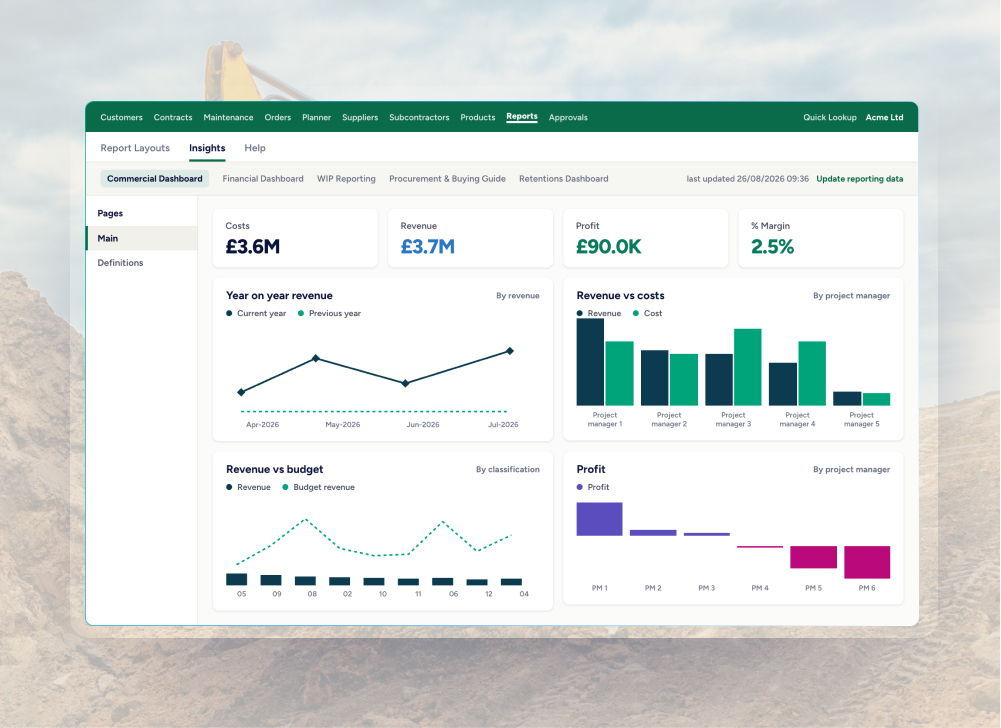
But new software tools are being developed to rid construction firms of such headaches. Construction software enable all invoices to be inputted into a single platform and logged by date. By providing employees with access to the system, they can pull out the vital information – whether a project is making money or not – with ease.
Uniting commercial systems with financial systems, such software provides greater confidence, better decision-making and ultimately better projects.