

The construction industry has faced several ongoing challenges in recent years, from labour and skills shortages to material price increases and the lasting impacts of the pandemic. Collectively, these factors are exacerbating project delays and budget overrun, impacting productivity and profitability and made for a challenging set of circumstances at the beginning of 2024.
KPMG’s 2023 Global Construction Survey found that 37% of the construction firms surveyed had missed a budget or schedule target over the previous year whilst another recent report revealed that an extra 251,500 construction workers are needed by 2028 to meet expected levels of work.
Looking forward: the construction industry is poised for growth
Whilst a poor economic outlook and high interest rates meant construction starts were slow moving during the first half of 2024, it is not all bad news. In fact, there are signs that the outlook is looking brighter for the industry, with construction outputs on the up and the sector poised for a projected 16% increase in project starts over the next three years. Meaning, businesses should analyse their existing processes to examine how they can optimise their processes to increase visibility across projects, improve workflows and access real-time information.
As it begins to come out on the other side of a difficult few years, the Building Cost Information Service (BCIS) expects growth to return in 2025, with total new work output increasing 20% by Q2 2029. With the market beginning to turn, technology is going to play a key role in helping companies gain a competitive edge and capitalise on expansion. In order to grow their businesses, software with the capabilities to create consistent tenders, effectively track costs, find the best price on materials, and effectively manage their subcontractor processes to save time and help companies grow.
Tackling increasing costs on materials
A challenge the industry is grappling with is increasing and fluctuating costs, prone to the impacts of inflation. The BCIS predicts that building costs will increase by 15% over the next five years, with tender prices rising by 19% over the same period. Whilst technology usually involves an upfront investment to implement, it can then provide businesses with the means to make long-term savings. For example, comparing and identifying the best material prices from suppliers to produce fast and accurate tenders, while tracking requirements for different projects.
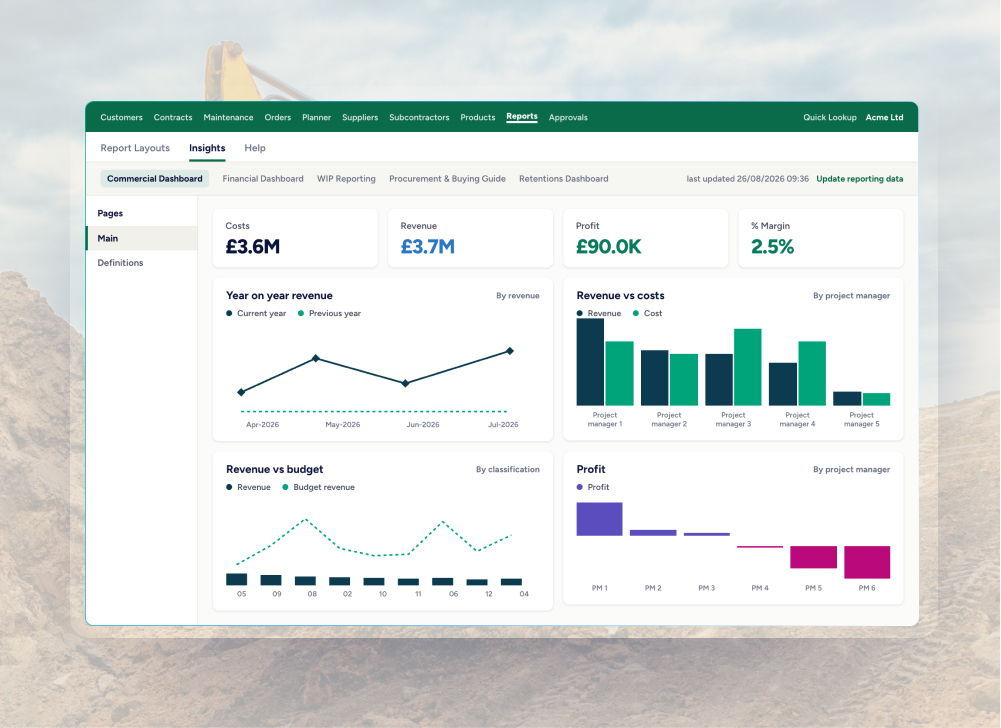
Construction companies need to adopt software that allows them to quickly price projects and produce bills of quantities while ensuring accuracy. Utilising technology that enables estimators to store pricing within a personal library provides companies with the most competitive prices from suppliers to be used within tenders. Additionally, businesses must ensure that commercial teams can accurately track budgets and costs against projects to manage profitability. This is especially important in the current environment, where costs are high and every penny counts.
Addressing labour shortages
In 2024, the sector is facing is labour and skills shortages. The Construction Skills Network reported construction employment predicts in 2024 construction employment will decline by 1.5% before an anticipated growth in 2025. Businesses can combat against through better recruitment processes, more apprenticeships available to upskill the younger generation, retention strategies and challenge negative perceptions.
Historically, the construction industry has been slow to embrace digitalisation. Whilst it’s no surprise due to limited time and available funds, in a candidate’s market, companies should look to give themselves a competitive edge. Striving to drive quality and bettering processes, investing in technology is a contributing factor in making a company attractive to a candidate. As well, it protects companies against resourcing complication by creating an effective work environment through automated workflows to reduce workloads.

How software can support the construction industry to advance
To heighten accuracy and increase productivity, construction companies are looking to implement intuitive software to ensure various departments across their business can access information from a single source. Unlike manual processes, standardised accounting platforms and disparate systems, construction-specific accounting and ERP systems provide real-time updates across integral information which improves visibility, optimises workflows, and enhances reporting on your contracts.
Cloud-based construction-specific technology
For construction companies with workers on site, at home, and in the office, being able to reduce unnecessary data silos and access accurate, up to date information from any location, on any device, is vital to boosting productivity and avoiding delays. Cloud-based technology can be used to better manage administrative tasks from timesheets and purchase orders to delivery orders and invoicing.
Automating key processes
Manual data entry, whether into spreadsheets or systems, is prone to human error and is time-consuming, often requiring additional resources to correct mistakes. Businesses can streamline processes by adopting an integrated solution. Compared to disconnected systems or manual processes, direct integration enables a seamless connection between two systems, ensuring that data is automatically posted. Automation allows for companies to optimise workflows by speeding up data entry and reducing the likelihood of mistakes. Additionally, efficiency savings can be achieved by replacing time-consuming manual tasks, while also providing greater financial control by automating the approval process.
Improved communication across teams
Establishing greater collaboration and communication, helping to avoid task repetition and unnecessary duplication in your data sets. As well, connecting your teams allows companies to improve visibility.
Introducing software with mobile app functionality, allows on-site and office staff to become better connected. Construction companies can share information between the site and the office, ensuring everything is recorded quickly and accurately. Whether it is raising purchase orders from a mobile device or easily completing and submitting time sheets to the better tracking of goods and delivery notes, mobile apps can help sites modernise, avoid duplication and reduce paper use in light of more stringent ESG regulations.
Accuracy within subcontractor management
Subcontractors play an integral role within construction supply chains. However, subcontractor management must be a precise and timely to ensure businesses do not incur fines. Adopting construction-specific software can take the stress out of dealing with an increasing number of subcontractors by automating warnings on insurance policies, CIS deductions, submit returns online and track CSCS.
How can Eque2 help?
Eque2 provides solutions designed specifically for the construction industry, a broad product suite to support estimating, contract & accounting, maintenance and housebuilding. As a specialist construction software provider, we have an in-depth understanding of how construction companies work and the challenges you face.
With over 3,000 customers, we’ve established ourselves as the UK & Ireland’s industry leading solution provider. Our dedicated construction accounting and ERP software that works with Microsoft Dynamics 365 Business Central, Sage and Xero to help businesses of varying sizes to eliminate risk, optimise processes and drive visibility of key information.
Construct for Sage/Xero Accounts is a fully cloud-based, contract accounting solution, providing small to medium businesses with the tools you need to run and manage your business effectively. With direct integration with Sage or Xero, the system helps businesses to increase margins, manage projects and save time and money.
EVision is suitable for large and enterprise business. A construction-specific ERP software that enhances Microsoft Dynamics 365 Business Central solution. EVision touches all corners across a business, allowing you to complete projects on time and within budget, giving you full control of your commercial, financial, and operational processes and data.
EValuate helps businesses produce accurate and consistent tenders and track budgets and costs effectively against projects for both pre and post contract – providing benefits throughout the commercial team for estimators, quantity surveyors, commercial management, and finance teams. The estimating solution helps improve productivity, win more work and deliver projects on time and within budget.
Whether it is producing tenders, costing jobs, managing maintenance, or simplifying invoices, we have a solution to address the challenges facing the sector today. To find out how our software can meet the needs of your business, get in touch.