


Specialist contractors have never had more work to chase, or less time to price it properly. Programmes are tighter, main contractors want answers in days and material prices can move between one tender and the next. Somewhere in that squeeze, the way tenders get priced hasn't kept pace with everything else the business has had to become.
Most estimating setups were built for a smaller business, and they start to creak as tender volumes grow. More estimators join with their own methods, key tools sit in isolation and the manual work grows faster than anyone has time to control.
By the time a problem shows up, the chance to fix it has usually gone. The MD finds out about margin at the final account, long after it could have been protected.
This playbook breaks down the three key challenges specialist contractors face on a daily basis, the effect each one has on contractors tenders and the early warning signs that your estimating setup is starting to fall behind the business.
The Current Position
Every specialist contractor follows some version of this journey from tender invitation through to handover - even if nobody's ever mapped it out step by step. Here's what those eight stages look like today, from the moment an enquiry lands to the day the site team picks up the job.
The Obstacles Specialist Contractors Need to Overcome
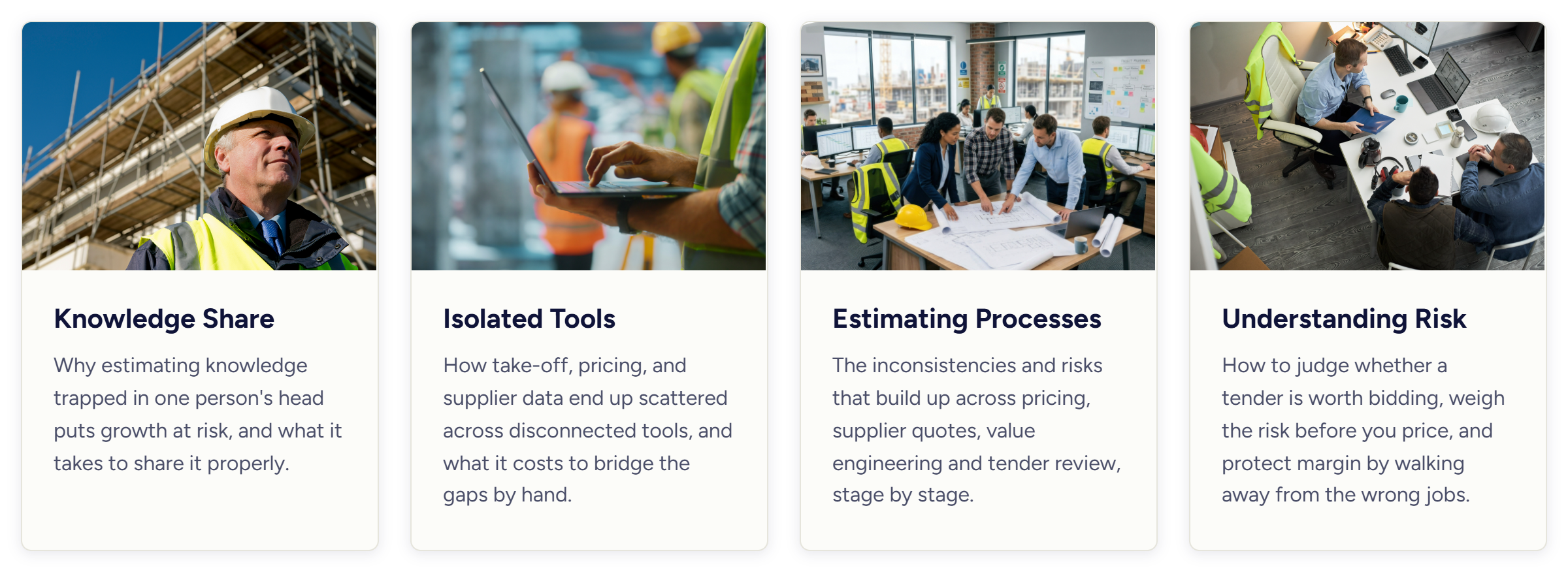
Knowledge Share
Sharing estimating knowledge sounds simple - write it down, pass it on, move to the next job.
But dig deeper and that knowledge is really scattered across one person's head, a handful of personal spreadsheets, and habits nobody ever wrote down: which supplier to call, how to price a tricky detail, what a "safe" margin looks like on a job like this one.
Multiply that across every estimator, every leaver, every new hire, and every job that still needs pricing while someone's on leave, and the exposure compounds fast - quietly, until the day it doesn't.
This chapter unpacks where that knowledge really lives today, and what it takes to move it out of people's heads and into the business - not just to reduce the risk, but to give every estimator a real foundation to build on.
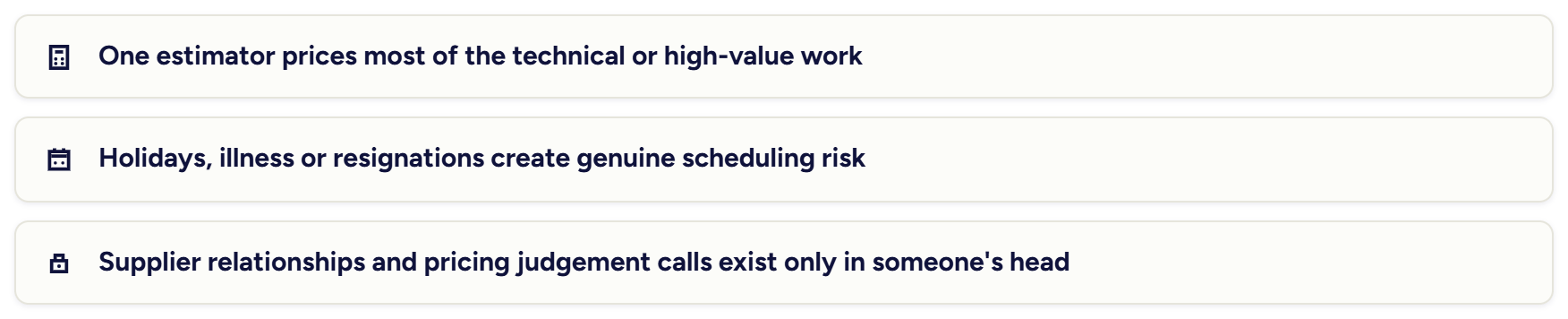
Estimating knowledge lives in one person's head, not the business
Every specialist contractor follows some version of this journey from tender invitation through to handover - even if nobody's ever mapped it out step by step. Here's what those eight stages look like today, from the moment an enquiry lands to the day the site team picks up the job.
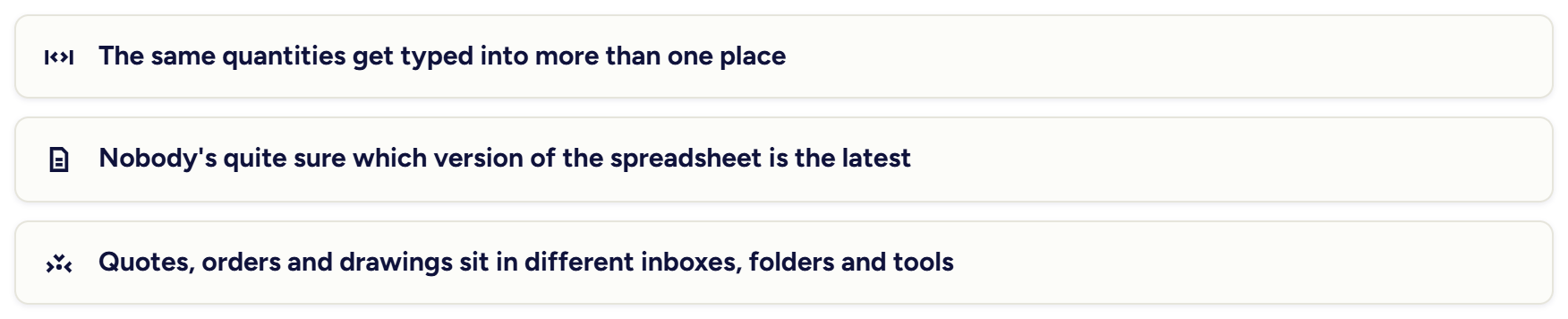
Estimating knowledge is built one tender at a time, inside each estimator's own spreadsheet. Nobody is asked to record why a rate is what it is - only what the number is - so the reasoning never leaves the person.
One contractor's lead estimator was about to go on paternity leave, and the team admitted they would struggle if anything urgent came up while he was away. Not because anyone lacked ability, but because every rate, supplier relationship and judgement call behind pricing a difficult job existed only in his head.
It's invisible right up until the moment it isn't. A holiday, an illness or a resignation, and the business is exposed in a way nobody planned for.
New estimators take months to get up to speed

Most estimating teams have never written down how they price. The method exists as habits inside each estimator's spreadsheet, so training becomes imitation - and a new starter inherits whichever method they happened to sit next to.
It doesn't have to work that way. One contractor hired an estimator from outside the industry entirely, and they ramped up quickly because the pricing process was already standardised. There was something concrete to learn from on day one, not a senior estimator's personal method to absorb by osmosis
Estimating Processes
When you’re managing your tenders, you think of it as two or three stages.
But dig deeper and it's really a dozen smaller ones - pricing, chasing supplier quotes, value engineering, reviewing scope, adjudicating margin - each with its own inconsistencies, and its own room for something to slip through.
Multiplied across every tender a team prices in a year, and every estimator doing it their own way, those small inconsistencies compound into real risk and real cost.
This chapter breaks that process down stage by stage, showing where confidence, accuracy, and capacity quietly leak away - and what it takes to close those gaps for good.
Every estimator prices differently - and nobody's fully confident in the number
This is where the £35,000 from the start of this playbook was lost. One contractor priced a job with a hidden formula error in a spreadsheet nobody had any reason to double-check. Nobody was careless. There was simply no way to see the number was wrong until it was already in the tender.
That contractor wasn't unlucky. When researchers audited real business spreadsheets, 94% contained errors, and around one in twenty formula cells was wrong. Every estimator builds their own spreadsheet over years of pricing, with their own layouts, formulas and shortcuts. Each one works for its owner. Without a shared structure, though, there's nothing to compare, check or standardise against.
Give the same small job to two of your estimators and compare how they got there, as well as the totals. Most teams find two different methods behind two different numbers. That rarely matters day to day. It matters a great deal when a job needs a second pair of eyes, or when the MD asks a margin question nobody can answer with confidence.
When every estimator builds a price the same way, from the same rates, a reviewer can check the method instead of working it out backwards. A hidden formula also has far fewer places to hide.
Supplier pricing goes stale the moment it's chased down
Every tender means going back to suppliers for fresh prices, and there's good reason to. The government's 'All work' material price index rose 5.4% in the year to May 2026, including 2.2% in a single month, and individual products have moved further than that. The chasing is still manual, though: emails sent and PDFs keyed back into rates by hand. That work lands on top of take-off and rate build-up, and when three tenders are due in the same week, it's usually the first thing to get squeezed.
Once quotes come back, they end up scattered across inboxes and individual estimators' spreadsheets. Nobody can see what a supplier is charging today next to what they charged on the last five jobs. A rate is only as current as the last time someone updated it by hand, and on a volatile line like insulation, that might have been one tender ago. If a job's whole margin is 2%, a rate that's a few percent out has already used it up.
Without that history, judging a quote comes down to memory. A price that matches what you used last time feels right, even if the market has moved or another supplier would have come in lower. The cost rarely arrives as one big loss. It shows up as a small slice of margin given away tender after tender, which is why it's so easy to miss.
Value engineering gets skipped because there's no time to redo the numbers
Picture a main contractor asking for an alternative board specification two days before the deadline.
In a spreadsheet, that alternative isn't a simple change. It's often a copy of the entire estimate. Swapping one board or system means finding and updating every affected rate by hand, and the risk of missing something makes estimators understandably cautious.
Offering a lower-cost specification or an alternative scheme should be a competitive advantage. It's how contractors demonstrate value, not just a lower price. But when repricing an option means rebuilding large parts of the tender, it's often the first thing dropped when time is tight. Unfortunately, that's often where the opportunity to stand out was.
If alternative specifications can be priced against the same take-off, without duplicating the estimate, value engineering becomes a deliberate choice rather than a last-minute headache.
Tenders are hard to check before they're submitted

Most tender reviews rely on one experienced person reading through the final spreadsheet. That's good at catching wrong numbers and poor at catching missing ones - you can't spot a floor that isn't there.
One contractor nearly found out the expensive way. An entire floor was left out of a tender, and it was only caught by chance in a final review - not because any process was built to catch it. Near misses like this never make it into a case study, because nothing went wrong in the end. But it easily could have.
With take-off, pricing and past tenders in one place, a reviewer can check what's been measured against what's been priced and compare the job with similar tenders, rather than relying on a read-through alone.
Understanding Risk
Is it worth bidding for the job?
Before anyone opens a drawing, one question decides whether the next few days of estimating time are well spent: is this job worth bidding for? Our in-house QS answers it with a simple model borrowed from climbing.
A climber has four points of contact and can only safely move one at a time. With three points secure, moving the fourth is controlled. Move two at once, and a slip becomes a fall. In tendering, the three secure points are clear scope, an achievable programme and a reliable client. The fourth, acceptable risk, is the one you can choose to move - but only once the other three are locked down.
The Mountain Climber Theory
Work through the four points in order when a tender arrives, and answer each question honestly before any measuring starts.
1. Clear scope
- Are the drawings complete enough to measure with confidence?
- Does the specification name the products and systems you would install?
- Are the interfaces with other trades clearly defined?
If it's loose, raise clarifications before you start pricing. If the answers don't come, treat it as a no-go.
2. An achievable programme
- Can your own labour and supply chain meet the dates?
- Do lead times on key materials fit the programme?
- Is there realistic time for your trade in the sequence?
If it's loose, price to a programme you can actually deliver and qualify it clearly - or walk away.
3. A reliable client
- Do they pay on time and settle variations fairly?
- How did the last job with them end?
- Are the payment, retention and liability terms reasonable?
If it's loose, it's usually a no-go. No amount of careful pricing fixes an unreliable client.
4. Acceptable risk - the one you can move
- What could go wrong that you can't design out?
- Can you price it, qualify it or exclude it?
- Would you still want the job if that risk happened?
Only move this point once the first three are secure. Then price the risk openly, through qualifications, exclusions or a visible risk allowance.
Now look back at the hospital job at the start of this chapter. The drawings were vague and the scope had holes, so the first point was already loose. Pressing on meant taking on risk as well - moving two points at once. That's how a winnable tender turns into £450,000 variations.
Working through the points leaves three possible answers. It's a go when scope, programme and client are all secure and the risk is ordinary. It's a go with conditions when those three hold but there's risk you can't remove - so you price it openly rather than hope it doesn't happen. And it's a no-go when scope, programme or client isn't secure. Decline early, and put the hours into a tender you'd actually want to win.
Walking away is a margin decision
Declining a tender can feel like turning away revenue. Look at the whole year's work instead of the single job, and it's often the opposite.
Estimating time is overhead. Every tender you price costs hours whether you win it or not, and that cost is recovered from the jobs you do win. Pricing tenders you shouldn't win raises the overhead every job has to carry.
A bad job also costs more than its margin. Unpaid variations, disputes, retention held back and cash tied up in a job that won't settle can wipe out the profit from several good ones. The hospital job at the start of this chapter didn't lose money at tender - it lost it in variations that were never paid.
That’s why it’s not always about the tender itself. It’s the processes and system you have in place to manage your mark-ups, estimates and cost management. If they’re not able to make your team more efficient and accurate in their process, or track pre and post contract. You’ll find you’re turning down tenders as more opportunities come in.
What Contractors Can Do
Every problem in this playbook comes back to the same root cause: estimating knowledge and data scattered across people and tools. This chapter looks at what changes when they live in one place.
More discipline helps, but it doesn't fix the underlying issue
For years, the answer to these problems has been more discipline - better spreadsheet templates, tighter checklists, more thorough handover notes. It helps, but it doesn't fix the underlying issue: the information is still scattered across people and tools, and still depends on whoever happens to be available on a given day.
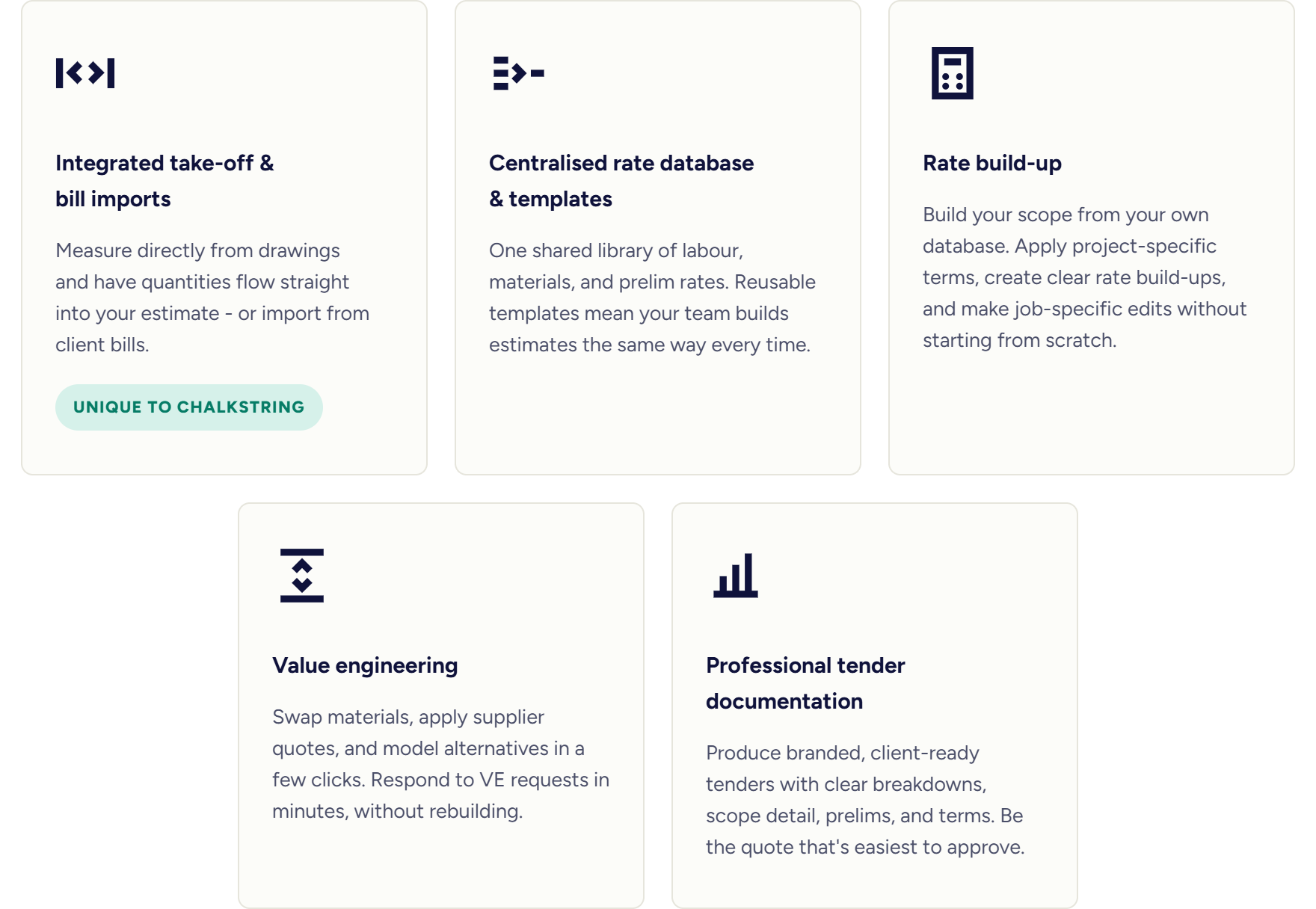
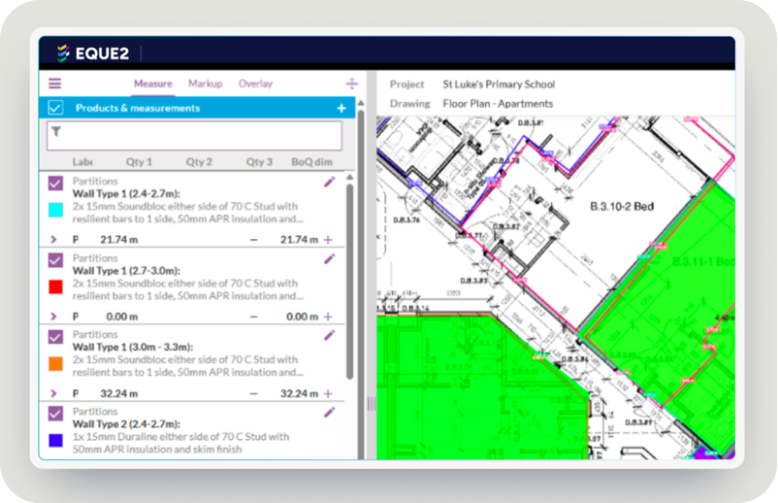
Construction estimating software takes a different approach. Instead of adding process on top of disconnected spreadsheets and folders, it puts take-off, rate build-up, supplier pricing, and tender management into one system the whole team works from - so consistency, speed, and confidence become a property of how the business is built, rather than something that rests on any one person's discipline.
One shared system instead of a folder of spreadsheets
Chalkstring is integrated estimating and tendering software built for specialist contractors. Chalkstring doesn't change how estimating works. It changes what estimating is built on - one shared system instead of a folder of spreadsheets, so the same information is available to everyone who needs it, in the format they actually use it. With Chalkstring, businesses establish real, repeatable processes that support business continuity and accuracy.
Built for specialist contractors
Every feature reflects how your business actually prices work - not how a main contractor or a generic platform thinks it does.
Statistic Sources
- 41,200 extra workers a year to 2030; too many experienced workers leaving (CITB Construction Workforce Outlook 2026–30, via Tile Association)
- 'All work' material prices up 5.4% in year to May 2026, 2.2% in one month (DBT building materials commentary, June 2026)
- Headline index hides larger movements for specific products (DBT building materials commentary, February 2026)
- 94% of audited spreadsheets contained errors; around 5% of formula cells wrong (Raymond Panko field audits, summarised in Spreadsheet Risk Management in Organisations
.png)