


Construction is an industry where even the most minute commercial movements can have a surprisingly big impact on the bottom line. The problem is, these movements are often so small that they’re incredibly difficult to see in isolation.
It’s the same story: A variation is not resolved when it should be. A payment application takes longer to assess. A subcontractor’s progress is
ahead of the position recorded in the commercial system. A cost commitment changes, but the forecast does not.
When margins are tight, a handful of unresolved variations, unexpected costs or discrepancies in subcontractor applications can quickly add up. Individually, these problems may seem minor. But together, they can create a growing gap between what was expected and what the project is actually delivering, ultimately impacting profitability.
That’s why subcontractor management deserves to be considered more than a supply-chain or administrative discipline, particularly when it’s so closely connected to commercial control.
When small movements become a big problem
That might sound obvious. After all, subcontractor costs make up a significant proportion of project expenditure. But the way businesses manage those relationships does not always reflect their financial importance.
Procurement, project delivery, commercial teams and finance can each have a different view of the same subcontractor relationship, with information passing between them through a mixture of systems, spreadsheets, documents and conversations.
The result is not necessarily a lack of data, but a lack of connected data. In a business where margins can be relatively narrow, that distinction matters.
Recent figures from the Single Source Regulations Office put that into perspective. Its 2025 construction analysis found a median underlying profit rate of 3.31% among its comparator group of construction companies for 2025/26. While this isn’t representative of the entire industry, it highlights just how little room there can be for costs to drift unnoticed.
At that level, protecting margin doesn’t come down to pinpointing finding one major saving, but instead preventing a succession of relatively small losses from becoming embedded in the final account.
That changes the way we should think about subcontractor management.
The cost of finding out too late
A subcontractor is not simply a supplier that needs to be appointed, monitored and paid. The subcontract relationship represents a stream of commercial events that can continually alter the financial position of a project. Orders create commitments. Progress creates applications. Scope changes create variation
s. Assessments create liabilities. Disputes create uncertainty. Final accounts crystallise the outcome.
The question, therefore, isn’t simply whether a business has processes for managing those events. The more important question is how quickly those events become visible as commercial information.
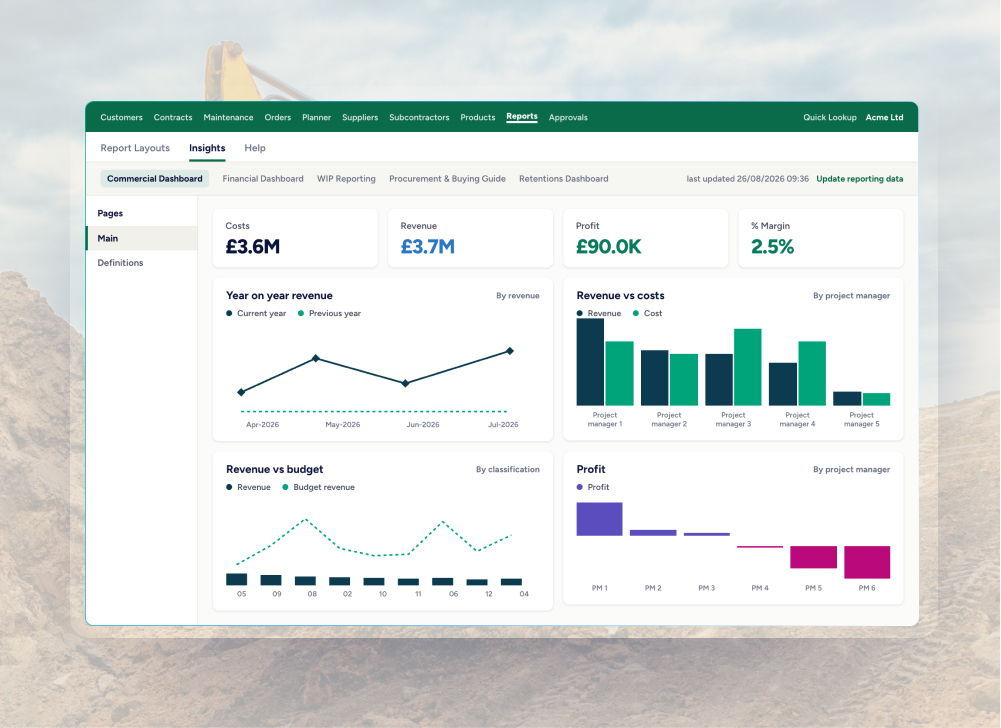
There is an important difference between reporting and control:
- Reporting tells you where you are.
- Control gives you an opportunity to influence where you are going.
That distinction becomes particularly important in construction because projects are constantly moving. The commercial position at the end of a reporting period is, in many respects, a snapshot of decisions and events that have already taken place.
If a project team discovers during a month-end review that a subcontract package has moved materially away from its expected position, there may be relatively little it can do about the costs that have already been incurred.
A variation that could have been challenged or negotiated when the work was being planned becomes far harder to influence once the work
has been carried out. A discrepancy in progress discovered after month-end can mean the forecast is already working from yesterday’s picture. And by the time an issue reaches final account, the question may no longer be how to prevent the cost, but how much of it can realistically be recovered.
The more useful information would have been available earlier.
This is where subcontractor management becomes a commercial issue rather than simply an operational one. If applications, variations, commitments and progress are being managed in isolation, the organisation may have the information it needs but still lack the visibility required to act on it.
The delay between an event occurring and its commercial significance becoming understood is itself a form of risk. The larger and more complex the supply chain, the more significant that gap can become.
HS2 offers a particularly stark example
The recent experience of HS2 illustrates what can happen when commercial controls fail to keep pace with project complexity.
In its May 2026 report, HS2 acknowledged that its ability to settle commercial matters progressively had deteriorated, allowing backlogs to develop around cost verification, contract finalisation and change. Its response has included stronger commercial controls, including greater scrutiny of payment applications and contractor claims, alongside improved tracking of planned work against actual progress.
The lesson learned here is that this underlying principle applies at every scale: the later a business understands what has changed commercially, the fewer opportunities it has to influence the outcome.
When subcontractor activity is managed across disconnected systems, spreadsheets and email chains, the business can have plenty of information without having a clear commercial picture.
This doesn’t mean more reporting. It means better-connected information, available at the point where decisions need to be made.
For example, a payment application becomes far more useful when it can be considered alongside the original subcontract order, progress, variations and the wider project position. The same applies to changes in scope or emerging costs. The earlier these movements are visible and understood, the more opportunity there is to challenge, resolve or account for them before they become embedded in the final cost.
Improving control across the supply chain
A clearer, more consistent process shouldn’t mean adding more administration for everyone involved. Instead, it can make the existing process easier to manage and easier to understand – reducing the need for repeated chasing, improving visibility of submissions and creating greater certainty around what has been received, reviewed and agreed.
Ultimately, commercial control is about reducing the distance between what is happening across the supply chain and what the business knows about its financial impact. For construction businesses operating in an environment of tight margins and increasingly complex supply chains, that distinction matters.
The key to protecting profitability is changing the question from “Are we managing our subcontractors effectively?” to “Can we see the commercial impact of what’s happening with them early enough to do something about it?”
Creating that visibility doesn’t necessarily require another layer of administration. It means giving internal teams a clearer, more connected way to manage the information and commercial activity that already exists.
That’s the focus of our upcoming webinar – Improving Commercial Control Across the Supply Chain: How Contractors are Bringing Subcontractors into One Connected Platform.
The session explores how a more connected subcontractor process can help streamline applications and give commercial teams greater control over the information that feeds into project performance.
Because when project margins can be shaped by hundreds of small commercial decisions, seeing those decisions clearly – and acting on them early – could make all the difference.